How to Choose Window Treatments That Reduce Afternoon Heat Without Blocking Natural Daylight
Every summer afternoon, the same bargain plays out in living rooms and home offices: pull the blinds and lose the daylight, or leave them open and let the room bake. The problem is worst on west-facing glass, where low, direct sun pours in for hours just as the day reaches its warmest point. Yet that afternoon light is exactly the light most people want to keep.
The short answer: choose a treatment that intercepts heat at the glass while still passing soft, usable daylight. For most west- and south-facing rooms, that means solar shades with a low openness factor, light-filtering cellular shades, or a solar shade layered with sheer curtains. Pick a light-coloured or reflective fabric, mount it to overlap the frame, and close it before the sun hits the glass.
Why Afternoon Sun Heats a Room Differently From Morning Light
Afternoon sun is harder on a room than morning sun for two reasons. It arrives at a lower angle, so it drives deep into the room and lands directly on floors, furniture, and anyone sitting near the window. It also arrives when outdoor temperatures peak, adding to warmth built up all day. A treatment that looks fine at 10 a.m. can feel useless at 4 p.m.
It helps to separate three things treatments control, because they are not the same. Heat gain is the solar energy that warms the room. Glare is the harsh brightness that makes screens unreadable. Daylight is the soft, usable light that lets you see comfortably without lamps. Blackout fabrics win on the first two and lose badly on the third. The treatments here manage all three: they reflect or scatter the sun's energy, soften its intensity, and still pass useful light.
Solar Shades: The View-Preserving Way to Tame a West-Facing Window
Solar shades are the closest thing to a direct answer for this problem. They are made from a tightly woven screen fabric that blocks a large share of ultraviolet rays and solar heat while leaving thousands of tiny openings that preserve your outward view. From inside, the room stays bright and you can still see the garden or street, a natural first option for living rooms and home offices.
The number that matters most is the openness factor, the percentage of the fabric that is open space. A 1% fabric is nearly solid and blocks the most heat and glare, but it also dims the room and softens the view. A 3% to 5% fabric is the usual sweet spot for afternoon sun: it cuts glare sharply and rejects much of the heat while keeping the room bright and the view clear. A 10% fabric keeps the brightest room but does noticeably less against heat.
Colour matters almost as much as openness. Light-coloured and white-backed fabrics reflect more sunlight back toward the glass, keeping both fabric and room cooler. Dark fabrics give a clearer view through the weave and better daytime privacy, but they absorb more heat, some of which radiates back indoors. Note that solar shades are a daytime solution: at night, with interior lights on, visibility reverses, so street-facing rooms need a second layer.
Honeycomb Shades That Turn Harsh Sun Into Soft, Even Light
Cellular shades, also called honeycomb shades, take a different approach. Instead of screening the sun through a weave, they diffuse it through pleated fabric cells that trap air between the glass and the room. That trapped air slows heat transfer in both directions, which also helps winter insulation. In a light-filtering fabric, they turn hard afternoon sun into a soft, even glow, and furniture and floors get far less direct sun.
The trade-off is the view. When a cellular shade is down, you cannot see through it, so it suits bedrooms, bathrooms, and rooms where diffused light matters more than the outlook. The feature that rescues the view is the top-down, bottom-up design, which lets you lower the shade from the top while the bottom stays closed. Lowering just the top third admits overhead daylight while the lower portion still blocks direct sun.
Sheers, Louvers, and Films That Scatter Sunlight Instead of Stopping It
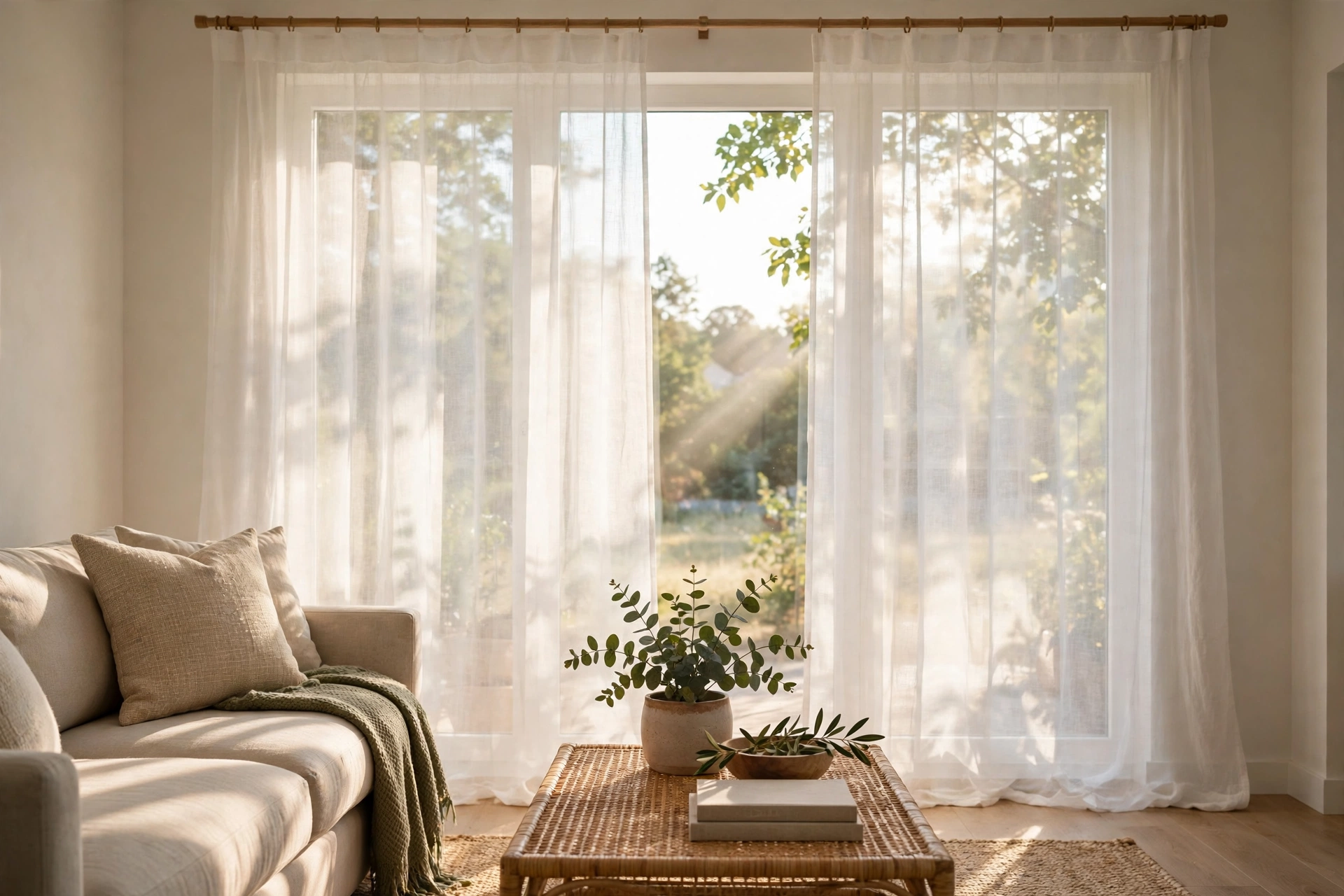
Not every solution needs to be a shade. Sheer curtains are the simplest way to soften afternoon sun: a lightweight linen or voile panel diffuses direct light across the room, kills the harsh hotspot on the floor, and keeps the space feeling open. On their own, sheers do little against serious heat, but layered over a solar shade they add softness and evening privacy while the shade underneath does the thermal work.
Adjustable louvers deserve attention too, especially in home offices. Horizontal blinds and plantation shutters let you angle slats upward so sunlight bounces onto the ceiling instead of onto your desk or screen, a trick known as daylight redirection. Light-coloured slats work best, since dark slats absorb heat and re-radiate it indoors. Window film is the invisible option, worth considering in a rental or where no shade can be mounted: a spectrally selective film rejects a share of solar heat and blocks almost all ultraviolet light while remaining nearly clear. Check film compatibility with double-pane or low-emissivity glass first.
Reading the Three Numbers Printed on Every Heat-Control Fabric
Three ratings decide most of the outcome. Openness factor tells you how much of a solar fabric is open weave. Ultraviolet blockage tells you how much fading-causing UV the fabric stops; good solar fabrics typically block 95% or more. Visible light transmission tells you how much daylight passes through, which predicts whether the room will still feel bright.
Layering for the Afternoon Peak, Then Opening Back Up at Dusk
The most comfortable rooms rarely rely on one treatment. The classic pairing is a solar shade for daytime heat and glare plus a lined drape for evening privacy: the shade works by day and the drapes take over at dusk.
Timing is the part most people get wrong. Closing a shade after the room has heated up traps warm air inside and forces the air conditioning to work against heat already stored in furniture and floors. Closing it before the sun reaches the glass keeps that heat out, which is why the most effective habit here costs nothing: lower west-facing shades by early afternoon, before the sun hits them. If you are away during the day, motorized shades scheduled to lower during peak sun hours earn their price, especially on tall or hard-to-reach windows. Battery-powered motors avoid new wiring, and cordless operation is safer around young children.
Measuring and Mounting Details That Decide Whether Heat Sneaks Around the Edges
A shade that leaves gaps around its edges leaks heat. Sunlight streaming past the sides of an inside-mounted shade lands directly on the floor and defeats much of the fabric's work. Outside mounting, where the shade covers the whole frame and overlaps the wall on each side, usually blocks more heat and light leakage, though it looks less tailored than a neat inside fit. On a severe west-facing window, the outside mount performs better. Measure width at top, middle, and bottom, and use the narrowest figure for an inside mount. Extend curtain rods beyond the frame so panels stack clear of the glass.
- Close the shade before the sun reaches the glass, not after the room feels hot.
- Overlap the frame on an outside mount so heat and light cannot leak around the sides.
- Keep the fabric light-coloured or white-backed when heat control is the priority.
What Afternoon-Heat Treatments Typically Cost, and Where the Money Goes
Prices vary widely by window size, fabric, and whether the treatment is ready-made or custom, so treat the figures here as broad estimates for a standard residential window rather than quotes. Ready-made solar and roller shades are the most affordable starting point, often running into the low tens of dollars per window for basic sizes, while custom-sized shades, cellular shades, and shutters climb higher as fabric quality and mechanism complexity increase.
Where the money goes matters more than the headline price. Fabric quality decides how long the treatment keeps its colour and shape under daily sun, since cheap fabrics can yellow, sag, or stiffen after a few seasons of western exposure. Mechanism quality decides whether the shade still glides smoothly in year five. And fit decides whether it performs at all: a mid-priced shade mounted well usually beats an expensive one hung with gaps.
Slip-Ups That Leave a Bright Room Still Sweltering
The most common disappointment is choosing a fabric for its looks alone. A beautiful dark linen roller shade may suit the room perfectly and still absorb heat all afternoon, radiating warmth back into the space it was meant to cool. Colour and openness should be decided before pattern and texture, not after. Buying blackout fabric for a room where daylight is the point leaves it cool and gloomy, with lights on at midday.
Another frequent error is treating every window in the house the same. North-facing glass rarely needs heat control, east-facing glass needs a morning solution, and west-facing glass needs the strongest afternoon treatment. Buying one fabric for the whole house over-treats the windows that do not need it and under-treats the ones that do.
When a Window-Treatment Job Belongs With a Fitter or a Glazing Specialist
Most standard shades and curtains are straightforward do-it-yourself jobs, but a few situations justify professional help. Very wide or tall windows, treatments mounted into steel lintels or concrete, and motorized systems wired into a smart-home setup are all easier and safer with a fitter who measures, mounts, and tests the mechanism. A professional measure also protects custom orders from costly measurement errors.
Call a glazing specialist rather than a shade installer if the problem is the window itself: condensation between panes, cracked or failed seals, or draughts around a warped frame. No interior treatment fully compensates for failed glazing, and a glazing upgrade may do more for comfort than any shade. Window film on double-pane or coated glass also belongs with a professional, since the wrong film can cause thermal stress and void a window warranty.
Afternoon Heat, Bright Rooms: Questions Homeowners Ask Before Buying Window Treatments
Do solar shades really keep a room cooler while keeping it bright?
Yes, within limits. A low-openness solar shade blocks a large share of solar heat and ultraviolet light while its woven openings still pass daylight and preserve the view. The room will be noticeably cooler and less glaring than with bare glass, though not as cool as with a blackout shade.
What openness percentage should I pick for a west-facing window?
For most west-facing rooms, 3% to 5% is a good starting point: strong glare and heat reduction with a bright room and a clear view. Choose 1% for a low, unobstructed western sun where heat matters more than brightness.
Can I keep my view and still get evening privacy?
Not with a solar shade alone, because visibility reverses at night when interior lights are on. The practical answer is layering: a solar shade for the day plus curtains, a roller shade, or a cellular shade that closes in the evening.
Are light-coloured fabrics actually better at blocking heat?
Generally, yes. Light colours and white-backed fabrics reflect more sunlight back toward the glass, so less heat is absorbed by the fabric and radiated into the room. Dark fabrics give a clearer view through a solar weave and better daytime privacy, but they absorb more heat.
Will window treatments alone fix a room that overheats every afternoon?
Sometimes, but not always. Treatments make the largest difference when overheating is driven by direct sun through the glass. If the room also has poor insulation or an undersized cooling system, shades will help but will not solve the whole problem.
Do I need motorized shades, or is a manual shade enough?
A manual shade is enough if someone is home to close it before the afternoon sun arrives. Motorization earns its cost when the house is empty during peak sun hours or windows are tall or hard to reach.
Choosing the Treatment Your Afternoon Sun Actually Needs
Start with the window, not the catalogue. Identify which windows take direct afternoon sun and for how long, decide whether the view or diffused light matters more in each room, and then match the fabric to that specific job: a low-openness solar shade where the view must survive, a light-filtering cellular shade where soft light matters more, and a layered combination wherever evening privacy is also required. Mount it to overlap the frame, choose a light colour, and close it before the sun arrives.