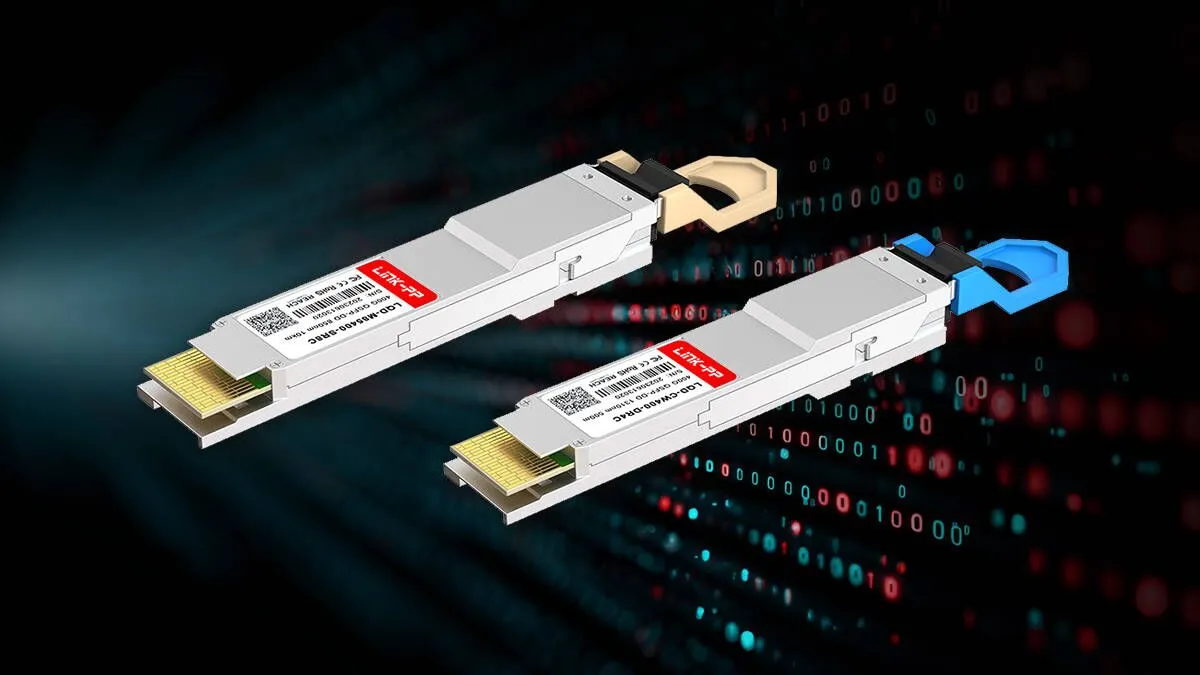
400G Optical Transceivers: QSFP-DD vs. OSFP vs. QSFP56 – A Decision Guide for Network Architects
The math is straightforward: global IP traffic is on track to exceed 5.3 zettabytes annually by 2026, and the compound annual growth rate for 400G optical transceivers is projected to hover around 15% through 2035. Hyperscalers, telecom carriers, and enterprise data centers are all racing to deploy 400G Ethernet, but the form factor question remains unsettled. Should you standardize on QSFP-DD, commit to OSFP, or take an intermediate step with QSFP56? The answer depends on your existing infrastructure, thermal budget, and long-term roadmap. This guide cuts through the marketing noise to compare these three dominant 400G form factors on the metrics that actually matter.
The 400G Imperative: Why Form Factor Matters Now
The shift to 400G is not merely about quadrupling bandwidth from 100G—it represents a fundamental change in how data centers architect their spine-leaf topologies. A single 400G port can replace four 100G links, reducing both power consumption and physical footprint. But 400G also introduces new challenges: PAM4 modulation doubles the data rate per lane but makes signal integrity far more fragile; thermal densities are rising faster than rack cooling capabilities; and the industry is split between competing form factor standards.
Network architects must choose not just a transceiver, but an ecosystem. The decision affects switch compatibility, cable plant, upgrade paths, and operational costs for the next five to seven years.
QSFP-DD: The Backward-Compatible Workhorse
QSFP-DD (Quad Small Form Factor Pluggable Double Density) is the evolutionary choice. It retains the mechanical footprint of the familiar QSFP form factor while doubling the electrical lane count from four to eight. This is achieved by adding a second row of contacts to the existing QSFP interface. The result: a module that supports 200G (8×25G NRZ), 400G (8×50G PAM4), and even 800G (8×100G PAM4) within the same physical envelope.
The killer feature is backward compatibility. A QSFP-DD port can accept legacy QSFP+, QSFP28, and QSFP56 modules, automatically configuring for lower data rates. This allows operators to deploy QSFP-DD switches today while populating ports with lower-cost 100G optics, then upgrade to 400G modules as traffic demands grow and budgets allow. The economic advantage is substantial: you pay for the higher-density chassis once, then fill it gradually.
On the optical side, QSFP-DD supports both 8×50G and 4×100G PAM4 architectures. The 4×100G approach—exemplified by the 400G-Q56DD-FR4—has become the industry’s preferred single-mode solution. In this configuration, the module converts eight 50G electrical lanes into four 100G optical channels using CWDM wavelengths (1271, 1291, 1311, and 1331nm), achieving 2km reach over duplex LC single-mode fiber. The 400G FR4 designation indicates four wavelengths in the FR (2km) reach class, and modules like the 400GBASE-FR4 QSFP-DD are fully compliant with IEEE 802.3bs and the 100G Lambda MSA. Compared to 8-wavelength FR8 designs, the 4×100G 400G QSFP-DD FR4 solution offers lower power consumption, simpler thermal management, and reduced manufacturing complexity—factors that have made it the market’s focal point.
The trade-off is thermal headroom. QSFP-DD’s compact dimensions (18.35mm × 89.4mm × 8.5mm) limit power dissipation to approximately 7–12W. For high-power ZR or coherent applications, this can be a constraint.
OSFP: The Clean-Slate Performance Play
OSFP (Octal Small Form Factor Pluggable) takes a different philosophy: design for performance first, compatibility second. Slightly wider and deeper than QSFP-DD, OSFP provides more PCB real estate and a taller profile for integrated heatsinks. This translates to 12–15W of thermal capacity—enough headroom for the most power-hungry 400G optics and a clearer path to 800G and beyond.
OSFP’s eight electrical lanes are arranged in a single row, which simplifies the connector and improves signal integrity compared to QSFP-DD’s dual-row design. Up to 36 OSFP ports fit in a 1U front panel, delivering the same 14.4Tb/s aggregate bandwidth as QSFP-DD.
The downside is equally clear: zero backward compatibility. An OSFP port cannot accept QSFP modules of any kind. This makes OSFP a “rip and replace” proposition—you commit fully to the new form factor at the time of switch deployment. For greenfield data centers or operators building entirely new 400G clusters, this is less of an issue. For those with substantial QSFP investments, it’s a dealbreaker.
QSFP56: The 200G Stepping Stone
QSFP56 is often misunderstood. It is not a 400G form factor—it is a 200G form factor that uses four lanes at 50G PAM4. However, QSFP56 plays an important strategic role in 400G migration paths. Because QSFP56 modules share the same physical dimensions as QSFP+ and QSFP28, they can be used in QSFP-DD ports, allowing a switch to operate at 200G per port.
The relevance to 400G planning is this: operators who deploy QSFP-DD switches can initially populate them with QSFP56 modules for 200G operation, then later upgrade to full 400G QSFP-DD optics as needed. This provides a “pay-as-you-grow” model that spreads capital expenditure across multiple budget cycles. For networks that do not yet require 400G but want a future-proof chassis, QSFP56 offers an intermediate on-ramp.
That said, QSFP56 is not a long-term destination. Its four-lane architecture cannot scale beyond 200G without a fundamental redesign—which is precisely what QSFP-DD and OSFP provide.
400G Transceivers applications
The growth of AI tokens is becoming a new driver for optical network upgrades. Every AI tool, whether used for search, writing, coding, design, or automation, depends on large-scale data center infrastructure. As token usage rises, AI service providers need faster networks to support real-time inference and large model training. 400G and 800G optical modules are well positioned to meet this demand because they offer higher bandwidth, better port density, and improved scalability compared with previous generations. In the future, the expansion of AI applications will likely push optical module technology toward even higher speeds and more efficient designs.
Making the Choice: A Framework for Decision-Making
The form factor decision ultimately comes down to four factors:
Existing infrastructure. If you have QSFP-based switches, optics, or cable plants, QSFP-DD is the only option that preserves that investment. OSFP requires starting from scratch.
Thermal requirements. If your application demands high-power optics (e.g., coherent ZR modules for DCI), OSFP’s superior thermal capacity is a significant advantage. For most data center interconnect applications under 2km, the 12W budget of a 400GBASE-FR4 QSFP-DD is entirely adequate.
Upgrade roadmap. If 800G is on your three-year horizon, both form factors support it—but OSFP’s larger thermal envelope may provide more breathing room for next-generation DSPs. QSFP-DD’s 800G roadmap is proven, but thermal constraints will be tighter.
Ecosystem maturity. QSFP-DD has a wider vendor ecosystem, broader switch support, and deeper supply chain depth. OSFP is well-supported but remains a secondary standard in many procurement pipelines.
For the vast majority of enterprise and cloud data centers, QSFP-DD is the pragmatic choice. Its backward compatibility reduces risk, its 4×100G FR4 optics like the 400G-Q56DD-FR4 deliver excellent price-performance for 2km reaches, and its ecosystem is unmatched. OSFP is better suited for greenfield high-performance computing clusters, AI training fabrics, and service provider networks where thermal headroom and raw performance outweigh compatibility concerns. QSFP56 is not a destination—it is a bridge, and a useful one for organizations pacing their 400G migration.
The 400G transition is not a single event but a multi-year journey. Choosing the right form factor today means choosing which upgrade paths remain open tomorrow. For most, that path runs through QSFP-DD.